
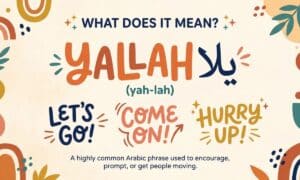
Walk down any busy street in Cairo, Beirut, Dubai or Tel Aviv, and you will hear one word again and again. Someone shouts it at a slow driver. A mom says it to kids who are running late. A friend types it into a group chat. That word is yallah. 😄
So what is the yallah meaning? In short, it means “let’s go,” “come on,” or “hurry up.” It is a short, punchy word that gets people moving. This guide explains how it works in Arabic, how people use it in texts and on social media, and when you should skip it. 👇
What Does Yallah Mean? 🤔
Core Definition of Yallah
Yallah (يلا) is an Arabic slang word. It works like a verbal nudge. You use it to get something moving, whether that is a person, a plan, or a whole group.
Most dictionaries and language blogs translate it as:
- Let’s go 🚶
- Come on
- Hurry up ⏰
- Okay, let’s do it
You will also see it spelled yalla or yala. All of them are the same word. The spelling changes because Arabic letters do not map neatly onto English ones.
Simple Explanation of Yallah
Think of it as a green light. It tells people the waiting is over. Say it to a friend at the door, and you mean “let’s leave now.” Say it after a meeting, and you mean “okay, let’s wrap up and start.”
The meaning is not fixed. Your tone and the situation decide it. A warm version feels friendly. A sharp version feels impatient. That flexibility is why the word is so popular. 💬
What Does Yallah Mean in Texting, Slang, and Social Media? 📱
In Chat Messages
In texts, it is a quick way to say “okay, let’s do it” or “I’m on my way.” It is short, casual and fast to type. Friends use it to settle plans without long messages.
- “Yalla, see you at 8.” → Okay, see you at 8.
- “Yalla?” → Are you ready? Are we going?
- “Yalla bye” → Alright, talk later. 👋
Yallah in Social Media
On Instagram, TikTok and X, the word shows up in captions, comments and hashtags. Creators use it to hype a video or invite followers to join in. Under a post, a simple “yalla!” can mean “you got this.” 🔥
You will also find it in the names of apps, brands and cafes across the Middle East. It signals energy and a friendly vibe.
Gen Z Usage
Younger people carry the word far beyond the Arab world. In Germany, it is part of youth slang in many cities, where it works like “komm schon” or “los.” In Israel, it is one of the most common words in everyday Hebrew. Gen Z also pairs it with other terms, like “yalla habibi,” in memes and voice chats. 🎮
Other Meanings of Yallah 🔍
The word is flexible. Here are the main ways people use it.
Encouragement 💪
It can cheer someone on. A coach, parent or friend might say it before a big moment. Fans shout it at football matches too. Here it means “you can do it” or “go for it.”
Hurry Up ⏳
This is the pushy side. If you are late, someone may say “yalla!” with a sigh. The tone carries the message. It can be playful, or it can show real frustration.
Starting Something 🎬
It also works as a starting gun. People say it before a meal, a trip, a game or a job. It means “okay, let’s begin.”
Ending a Conversation 👋
On the phone, people often say “yalla, bye” to close a call. It signals that the chat is over, in a friendly way. Think of it as “alright, I’m heading off.”
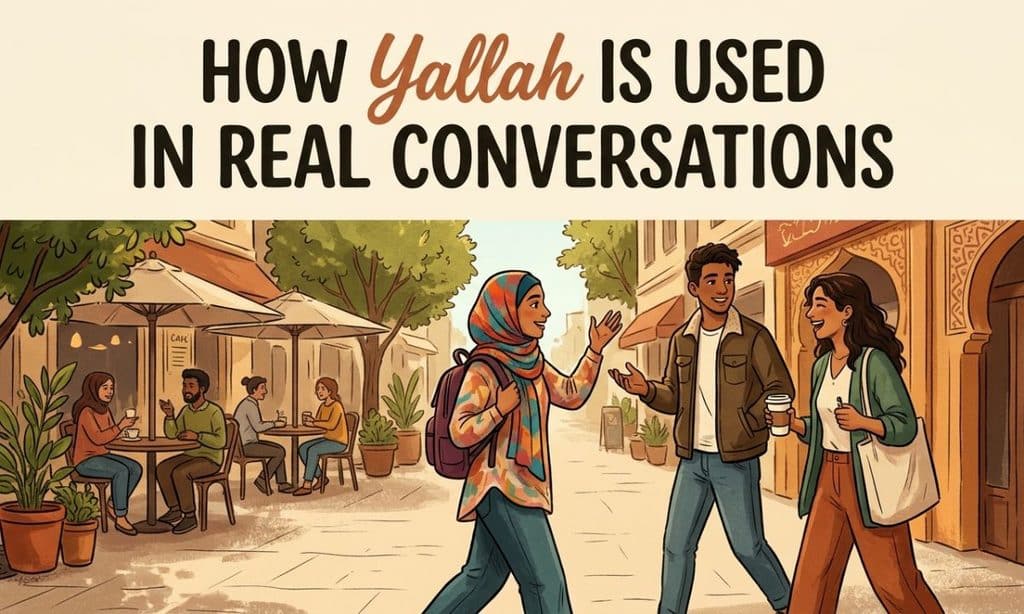
How Yallah Is Used in Real Conversations 🗨️
Everyday Situations
You will hear it in many daily moments:
- At home, when it is time to leave for school or work
- In traffic, when a car does not move after the light turns green 🚗
- At restaurants, when the group is ready to order
- At the gym or on the field, when the team needs energy
- On a call, when one person wants to hang up
Platforms Where Yallah Appears
Beyond face-to-face talk, it is common on WhatsApp, Snapchat, Instagram, TikTok, Discord and in online games. It also appears in song titles, ads and travel blogs. 🌍
Examples of Yallah in Conversations
Here are a few simple scenes:
- Friends heading out: “Yalla, the taxi is here!” → Come on, the taxi is here.
- Encouraging a friend: “Yalla, you can finish this.” → Come on, you can do this.
- Impatient moment: “Yalla, we’re late!” → Hurry up, we’re late.
- Ending a call: “Okay, yalla, talk tomorrow.” → Alright, talk tomorrow.
Tone and Intent Behind Yallah 🎭
Emotional Meaning of Yallah
The word carries energy. It can show excitement, urgency, support or annoyance. The same word can sound sweet or sharp. Listen to the voice, not just the word.
Positive, Negative, or Neutral Usage
- Positive: Cheering, inviting, motivating 🎉
- Neutral: Starting a task, ending a call
- Negative: Rushing someone, showing irritation 😤
Most of the time, it is neutral or friendly.
Sarcasm vs Serious Meaning
It can be sarcastic. A slow “yaaalla…” with a smirk may mean “sure, whenever you’re ready.” A quick, firm “Yalla!” is serious. In person, facial expressions help. In text, emojis fill the gap. 😉
ALSO READ THIS: Habibi Meaning in Text: Complete Guide to Viral Slang (2026)
Origin and Background of Yallah 📜
The word comes from the Arabic phrase “ya Allah,” meaning “O God.” Over time, people shortened and softened it. Today it works as a plain everyday interjection. Most speakers use it without thinking about the religious roots.
It spread across the Arab world and then beyond. Hebrew speakers adopted it because Arab and Jewish communities have lived side by side for generations. Today it is among the most used Arabic-origin words in Israeli slang. It has also entered Turkish, German and other languages through migration, music and social media.
Is Yallah Rude or Inappropriate? 🙅
No, it is not rude by itself. It is casual, not offensive. The tone decides how it lands.
- Said with a smile, it is friendly.
- Said with a snap, it can feel bossy.
- Said to a stranger or an elder, it may feel too blunt.
If you are unsure, soften it with a smile or add “habibi” for warmth. 😊
When Not to Use Yallah 🚫
Formal Communication
It is informal slang. Avoid it in business emails, job applications, official letters, speeches or academic papers. Use “let’s begin” or “shall we proceed” instead.
Wrong Contexts
Skip it when:
- Speaking to someone much older or in authority, unless you know them well
- Talking in a sad or serious moment, such as a funeral
- Dealing with someone who may take rushing as an insult
Similar and Related Terms 🌐
Many languages have a word like this. They are close in meaning but not identical.
- Come On: the English way to encourage or urge someone
- Let’s Go: a simple call to start moving
- Hurry Up: a direct request for speed
- Vamos: Spanish for “let’s go,” common in sports and daily life ⚽
- Allez: French for “go” or “come on,” common at matches and events
Related Terms Compared ⚖️
Yallah vs Let’s Go
“Let’s go” is plain English. The Arabic word adds cultural flavor and a bit more energy. It can also mean “okay, bye,” which “let’s go” cannot.
Yallah vs Hurry Up
“Hurry up” is always about speed. Yalla may mean hurry, but it can also mean “cheer up,” “begin,” or “see you later.”
Yallah vs Vamos
The two feel alike. Both are lively and friendly. But yalla plays more roles, like ending calls and showing impatience.
Quick Comparison Table
| Term | Language | Main Meaning | Tone | Ends a Chat? |
| Yalla | Arabic | Let’s go, hurry up | Friendly to impatient | Yes |
| Let’s go | English | Start moving | Neutral | No |
| Hurry up | English | Move faster | Pushy | No |
| Vamos | Spanish | Let’s go | Energetic | Rarely |
| Allez | French | Go, come on | Encouraging | Rarely |
Common Misunderstandings About Yallah 🧩
Yallah Meaning in Arabic
In Arabic, it means “let’s go,” “come on” or “hurry up.” You will hear it in Egyptian, Levantine, Gulf and other dialects.
Yallah Meaning Turkish
Turkish speakers also use it as a loanword. It often means “come on” or “get going,” and sometimes “shoo, go away,” depending on tone. The usual Turkish word for “let’s go” is “haydi.”
Yallah Meaning in English
English has no exact match. The closest options are “come on,” “let’s go,” and “hurry up.” Many English speakers now use it as slang too.
Yallah Meaning in Urdu
Urdu has no native word called yalla. Urdu speakers say “chalo” for “let’s go.” They do say “Ya Allah” as a prayer or exclamation, meaning “O God.” It is related, but used differently.
Yallah Meaning German
In German youth slang, it means “los” or “komm schon.” It is common in cities and in online talk.
Yallah Meaning in Islam
It is not a religious phrase or ritual. It comes from “ya Allah,” but people use it as casual slang, not as a prayer.
Yalla Bye Meaning
“Yalla bye” means “okay, bye” or “alright, talk later.” People say it to close a call or chat.
Yalla Habibi Meaning
It can mean “come on, my friend” or “let’s go, dear.” It is warm and playful. Some people also use it as a casual hello.
Frequently Asked Questions ❓
Why do Arabs say yallah?
It is a quick, flexible way to ask people to move, begin or finish something. It saves words and carries emotion.
What does “yallah” mean?
It means “let’s go,” “come on” or “hurry up.” It can also mean “okay, bye” at the end of a chat.
Is Yalla rude?
No, it is not rude by default. Tone matters, so a sharp delivery can sound pushy.
What does yallah habibi mean?
It means “come on, my friend” or “let’s go, dear.” It is friendly and casual.
Why do Israelis say yalla?
Hebrew borrowed the word from Arabic, and it became a staple of Israeli slang. Israelis use it for “let’s go” and “okay.”
How do Arabs say “OK”?
Common choices are “tamam,” “mashi,” “tayeb” or “okay,” depending on the dialect. Yalla can also mean “okay, let’s do it.”
How do Muslims say “I love you”?
In Arabic, people say “ana bahebbak” to a man and “ana bahebbek” to a woman. In a religious sense, “uhibbuka fillah” means “I love you for God’s sake.”
How do I respond to Yalla?
Reply with “yalla,” “okay,” “tamam,” or “coming!” If it is a hurry, just start moving. 🏃
Conclusion ✅
The yallah meaning is simple at heart: it is an energetic nudge. It can mean “let’s go,” “hurry up,” “you can do it,” or “okay, bye.” Tone, context and your relationship with the person decide the rest.
Learn to hear the mood behind it, and you will understand it almost anywhere. Use it with friends, in casual texts and on social media. Skip it in formal settings. Now you know the word everyone keeps shouting, so go ahead and try it! 🎉

With over 6 years of experience researching language, word origins, and modern communication, our author is passionate about making meanings simple and easy to understand. Every article is carefully researched to provide accurate definitions, usage examples, and practical explanations.