
If you’ve spotted “PDA” in a text, a TikTok comment, or an Instagram caption and felt a little lost, you’re not alone. You’ve probably seen “PDA” online, in a message, or even heard it in conversation—and wondered what it actually means.
The PDA meaning in modern chat and slang is simple once you break it down — and this guide covers every version of it, from romance to medicine to computers. Let’s dig in! 👇
PDA – Quick Meaning
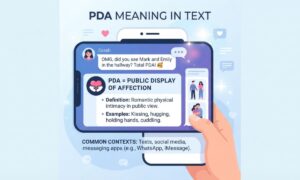
PDA stands for Public Display of Affection in everyday conversation.
Simple definition:
PDA stands for Public Display of Affection. It describes any visible act of romantic affection — hugging, kissing, holding hands, or cuddling — shown where others can see it, either in real life or online. 😘
Common examples:
- Holding hands at the mall 🤝
- Kissing in front of friends 💋
- Cuddling on a park bench 🌳
- Posting a couple selfie captioned “no PDA shame” 📸
Real examples in quotes:
- “They can’t stop with the PDA even in class 😂”
- “Honestly, I don’t mind a little PDA.”
- “Ok that’s too much PDA for a coffee shop 💀”
PDA meaning business
In a workplace or corporate glossary, the PDA meaning usually shifts to Personal Digital Assistant — a handheld device (think old-school Palm Pilot or BlackBerry) used for calendars, contacts, and notes before smartphones took over. 💼
PDA meaning in medical
In healthcare, PDA means Patent Ductus Arteriosus — a heart condition, common in newborns, where a blood vessel that should close after birth stays open. 🩺 This is a completely different context from the romantic slang use.
PDA meaning in computer
In computing and tech circles, PDA again refers to a Personal Digital Assistant — an early mobile device that managed schedules, contacts, and notes, and is also studied academically as a pushdown automaton in computer science theory. 💻
Origin & Background of PDA 📜
Where it started
The phrase “public display of affection” has roots in etiquette discussions from decades ago, describing romantic behavior considered acceptable — or not — in shared public spaces.
How it evolved
- 1980s–1990s: Movies and music normalized public affection, making the term more casual.
- 2000s: Texting culture shortened the phrase to the acronym PDA for quick typing.
- 2010s–2026: Social media (Instagram, TikTok, Snapchat) turned PDA into everyday slang used both sincerely and jokingly. The PDA meaning today stretches from a sweet compliment to a sarcastic jab.
Real-Life Conversations 💬
WhatsApp Chat
Mia: OMG did you see Sarah and Jake at the party?
Zara: Yes 😭 SO much PDA, I had to look away
Mia: Honestly cute though 🥹
Instagram DMs
user1: ur latest post is giving major PDA energy 😍
user2: lol we can’t help it 🥰
TikTok Comments
“The PDA in this video is unmatched 😭❤️”
“Bro get a room, too much PDA for the comment section 💀”
Also Read This: https://meanyup.com/hw-meaning/
Emotional & Psychological Meaning 🧠
Why people engage in PDA:
- Expressing genuine love and connection ❤️
- Building comfort and confidence as a couple
- Cultural or personal comfort with openness
- Social bonding — showing “we’re together” to friends
Why people dislike PDA:
- Feels like an invasion of shared public space
- Personal discomfort with intimacy on display
- Cultural or religious norms discourage it
- Can feel performative rather than genuine
Usage in Different Contexts 🌍
| Context | How PDA Is Used | Tone |
| Social Media | Captions, comments on couple posts | Playful, teasing, or sweet |
| Friends & Relationships | Casual banter about couples | Light-hearted |
| Work/Professional Settings | Generally avoided or discouraged | Formal, cautious |
| Casual Chat | Everyday texting about dating life | Relaxed |
Social Media
On platforms like TikTok and Instagram, the PDA meaning often becomes a running joke — think “PDA alert 🚨” in comments under couple videos.
Friends & Relationships
Among friends, PDA comments are usually teasing: “get a room” or “you two are so cute, stop.”
Work or Professional Settings
PDA is rarely acceptable in professional environments, since it can create discomfort among colleagues. 🚫
Casual vs Serious Tone
- Casual tone: Joking, memes, light teasing
- Serious tone: Genuine discomfort, boundary-setting, or relationship discussions
Other Acronym Meanings 🔤
PDA meaning acronym
Beyond romance, PDA is a flexible acronym across industries — Public Display of Affection, Personal Digital Assistant, Patent Ductus Arteriosus, and more, depending on context.
PDA meaning in construction
In construction and engineering circles, PDA commonly refers to a Pile Driving Analyzer — equipment used to test the load capacity of driven piles during foundation work. 🏗️
PDA meaning in work
At the office, “PDA” almost never refers to affection — it’s more likely shorthand tied to devices, project documentation, or internal acronyms specific to that company.
Common Misunderstandings About PDA ⚠️
What people get wrong:
- Assuming PDA always means something negative (it’s actually neutral — tone decides that)
- Thinking it’s only for romantic couples (friends use it jokingly too)
- Confusing PDA with other similar-looking acronyms
When meaning changes:
The PDA meaning shifts entirely based on setting — medical charts, tech reviews, and construction reports use it completely differently than a text thread about your friend’s new relationship.
When NOT to use it:
- In formal writing or professional emails
- When discussing sensitive medical topics without clarifying context
- In academic or technical writing without spelling it out first
Comparison Table 📊
| PDA Type | Full Form | Common Context |
| Romantic PDA | Public Display of Affection | Texting, social media, relationships |
| Business PDA | Personal Digital Assistant | Old handheld tech, business tools |
| Medical PDA | Patent Ductus Arteriosus | Pediatric heart condition |
| Computer PDA | Personal Digital Assistant / Pushdown Automaton | Tech history, computer science |
| Autism PDA | Pathological Demand Avoidance | Neurodivergence, autism spectrum |
| Construction PDA | Pile Driving Analyzer | Foundation testing equipment |
Variations / Types of PDA (10 Types) 💞
- Physical PDA – hugging, kissing, holding hands 🤗
- Emotional PDA – verbal affection, compliments in public 🥰
- Online PDA – couple posts, tagged photos, loving comments 📱
- Subtle PDA – a hand squeeze, a quick forehead kiss
- Excessive PDA – constant, over-the-top affection
- Playful PDA – teasing, tickling, joking affection 😜
- Formal-Setting PDA – minimal affection at work events
- Cultural PDA – varies heavily by region and tradition
- Friendly PDA – affectionate but platonic gestures among friends
- Digital-Only PDA – affection shown only through texts/DMs, not in person
How to Respond When Someone Uses “PDA” 💬
Casual Replies
- “Haha yeah we’re a little much 😅”
- “Guilty as charged 🙈”
Funny Replies
- “PDA level: expert 🏆”
- “We’re just very committed to the bit 😂”
Mature / Confident Replies
- “We’re comfortable showing affection, and that’s okay.”
- “Everyone expresses love differently.”
Private / Respectful Replies
- “We’ll tone it down, no worries.”
- “Fair point, didn’t mean to make anyone uncomfortable.”
Regional & Cultural Usage 🌎
Western Culture
PDA is widely accepted and often normalized in casual settings, though excessive PDA can still draw comments.
Asian Culture
Many Asian cultures traditionally view PDA as more private, though younger generations on social media are shifting this norm.
Middle Eastern Culture
PDA is generally discouraged or restricted in public settings due to cultural and religious values.
Global Internet Usage
Online, the PDA meaning has become culturally flexible — a global meme language where affection, teasing, and commentary blend together regardless of geography. 🌐
Special Contexts 🔎
Autism PDA meaning
In neurodivergence discussions, PDA stands for Pathological Demand Avoidance (sometimes reframed as “Pervasive Drive for Autonomy”) — a profile associated with the autism spectrum, marked by an intense need to resist everyday demands and expectations.
Toyota PDA meaning
Around car dealerships, “PDA” sometimes shows up as a line-item fee tied to port-installed accessories or pre-delivery prep on new vehicles. It’s unrelated to the romantic slang meaning and worth asking your dealer to clarify on any invoice. 🚗
Frequently Asked Questions ❓
What does PDA mean in a relationship?
It means Public Display of Affection — showing love openly through hugs, kisses, or hand-holding in front of others.
What does “PDA” mean in slang?
In slang, the PDA meaning is the same — Public Display of Affection — but used casually, sarcastically, or jokingly online.
What is PDA in behaviour?
It refers to visible affectionate behavior between partners, ranging from subtle gestures to more obvious romantic displays.
What does a PDA person mean?
It usually describes someone who’s comfortable being openly affectionate with their partner in public, whether occasionally or frequently.
What does PDA mean?
PDA means “Public Display of Affection” — showing love openly, like hugging, kissing, or holding hands in public. 💕
What does PDA mean in a text message?
In texting, PDA refers to a couple showing affection in public, often used casually or jokingly in chats. 📱
Is PDA a bad word?
No, PDA isn’t bad or rude — it’s neutral slang, and its tone depends on how it’s used in conversation. ✅
What does PDA stand for on social media?
On social media, PDA stands for Public Display of Affection, commonly used in comments about couples on TikTok and Instagram. 📸
What is the full form of PDA in love?
In relationships, the full form of PDA is “Public Display of Affection,” describing visible romantic gestures between partners. ❤️
Conclusion 🎯
At its core, the PDA meaning almost always comes back to Public Display of Affection — the go-to definition in texts, DMs, and comment sections.
But context is everything: the same three letters can mean a heart condition to a doctor, an old handheld gadget to a tech fan, or testing equipment to a construction engineer. Once you understand the PDA meaning in each setting, you’ll never be confused by those three letters again. 💖

With over 6 years of experience researching language, word origins, and modern communication, our author is passionate about making meanings simple and easy to understand. Every article is carefully researched to provide accurate definitions, usage examples, and practical explanations.