
You’ve probably heard shibal saekkiya in a K-drama, a movie or a viral clip. The actors shout it, the subtitles flash something harsh, and you’re left wondering what it really means. It sounds dramatic, and it is.
This phrase is a strong Korean curse. It’s a stack of two vulgar words, and together they work as an angry insult. It isn’t a friendly expression, a greeting or a cute phrase, and it doesn’t mean “I love you.”
In this guide, you’ll learn the literal translation, the true meaning, how it’s pronounced, and how offensive it is. You’ll also see related Korean words and clear examples, so you can understand it when you hear it without using it by mistake.
Quick Answer: What Does Shibal Saekkiya Mean?
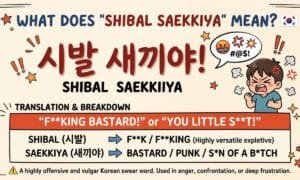
Shibal saekkiya (씨발 새끼야) is a vulgar Korean insult that roughly means “you f*ing bastard.”** It combines a harsh expletive (shibal) with an insulting noun (saekki) in a form used to address someone directly.
| Part | Korean | Rough English meaning |
| Shibal | 씨발 | F***, damn it (strong expletive) |
| Saekki | 새끼 | Bastard, jerk (insult) |
| -ya | 야 | Direct address (“hey you”) |
Use it only to understand what you hear. Don’t use it in real conversation.
Shibal Saekkiya Meaning in English Explained
In English, shibal saekkiya works like “you f***ing bastard” or “you damn jerk.” It’s said in anger, usually aimed straight at a person. The tone is hostile.
Korean learners often search for it because it’s heavily used in dramas, films and online clips. Understanding it helps you follow dialogue, but it also helps you avoid serious social trouble.
What Is the Literal Translation of Shibal Saekkiya?
The literal translation is built from its parts. “Shibal” is a vulgar expletive, comparable to the strongest English curse word. “Saekki” literally means the young of an animal, like a pup or a cub. The ending “-ya” is how you call someone directly.
So a close literal reading is “[expletive] you little creature,” which is why it feels so insulting. Literal translation alone doesn’t capture the anger, though.
What Is Its Actual Meaning in Korean?
In real Korean use, the phrase isn’t about animals or young creatures at all. It’s a direct, abusive way to call someone a terrible person. It carries rage, contempt or deep frustration.
Native speakers hear it as a serious insult. Context decides how heavy it lands, but it’s never gentle.
What Does Shibal Mean in Korean?
Shibal (씨발) is one of the most common strong curse words in Korean. People say it when they’re angry, shocked, hurt or in pain. It can also be an outburst at no one in particular.
Shibal Korean Meaning and English Translation
The closest English equivalent is the f-word. Depending on the sentence, it can mean “f***,” “damn it” or “what the f***.” Its exact origin is debated, and it’s often linked to vulgar words for sex.
Here’s how its meaning shifts:
| Situation | English feel |
| Stubbing your toe | “F***!” |
| Hearing shocking news | “What the f***?” |
| Yelling at someone | “F*** you!” |
Why Is Shibal Considered a Korean Swear Word?
Shibal is treated as a swear word for three reasons:
- It has vulgar roots tied to sexual language.
- It’s used to express extreme anger or aggression.
- It’s commonly bleeped, censored or softened in broadcasts and subtitles.
In Korean society, respect and politeness are deeply valued, so strong curses stand out even more.
What Does Saekkiya Mean in Korean?
Saekkiya (새끼야) is the call-out form of “saekki” (새끼). Think of it as “hey, you [insult].” It’s the part that points the insult at the listener.
Saekkiya Meaning in English
Saekkiya means “you bastard” or “you jerk.” Used alone, it can range from harsh to playful depending on tone and relationship. Combined with shibal, it becomes much stronger.
Why Is Saekkiya Considered an Insult?
“Saekki” originally means the offspring of an animal. When applied to a person, it reduces them to something lowly. In curse form, it works like “bastard” or “son of a b****” in English.
Among very close friends, saekki can sometimes be said jokingly. From a stranger or in anger, it’s a real insult.
Is Shibal Saekkiya a Bad Word?

Yes. Shibal saekkiya is a bad word and a strong profanity. It belongs in the category of language you would not say in front of parents, teachers, bosses or people you’ve just met.
How Offensive Is This Korean Curse Word?
It’s highly offensive, near the top of the Korean insult scale. Here’s a simple guide:
| Level | Example type | Offensive? |
| Mild | Aish (아이씨) | Low, like “ugh, damn” |
| Medium | Saekki alone | Moderate |
| Strong | Shibal | High |
| Very strong | Shibal saekkiya | Very high |
Insulting someone in public can even carry legal consequences in Korea in some situations.
When Should You Avoid Using Shibal Saekkiya?
Avoid it:
- With elders, teachers or anyone senior
- At work or in any formal setting
- With people you don’t know well
- Online, where tone can’t be explained
- As a joke when you’re a language learner, since it often backfires
How Is Shibal Saekkiya Used in Korean Conversations?
Native speakers use it only in heated or very casual situations. It’s not part of polite daily talk, and many Koreans avoid it entirely.
Using Shibal Saekkiya When Angry
The most common use is in a fight or a burst of rage. It can be aimed at a person who cheated, lied or caused harm. It can also be shouted at a situation, like a computer crashing or a failed exam.
Shibal Saekkiya in Korean Dramas and Movies
Korean dramas and films use it to show intense emotion, especially in crime, thriller and gritty drama scenes. Writers use it to show that a character has lost control. Be aware that English subtitles sometimes soften it, so what you read may be gentler than what’s said.
Do Close Friends Use Shibal Saekkiya With Each Other?
Sometimes, particularly among younger men who are very close and joke around. Even then, it depends on the group and the tone. As an outsider or learner, don’t assume it’s safe, because you can’t easily read the line between playful and offensive.
Shibal Saekkiya vs. Other Korean Swear Words
Korean has many curses. Shibal saekkiya is one of the strongest, but not the only one.
Shibal vs. Gae Saekkiya
Shibal is an expletive. Gae saekkiya (개새끼야) literally means “you son of a dog” and is a standalone insult aimed at a person. Shibal saekkiya mixes both, making it even harsher.
Shibal Saekkiya vs. Other Korean Insults
Compared with milder insults such as “babo” (fool), shibal saekkiya is far stronger. Babo is mocking. Shibal saekkiya is hateful.
Common Korean Curse Words and Their English Meanings
| Korean | Romanization | English meaning | Strength |
| 바보 | Babo | Fool | Mild |
| 아이씨 | Aish | Damn, ugh | Mild |
| 새끼 | Saekki | Bastard, jerk | Medium |
| 개새끼 | Gae saekki | Son of a b**** | Strong |
| 씨발 | Shibal | F*** | Strong |
| 씨발 새끼야 | Shibal saekkiya | You f***ing bastard | Very strong |
How to Pronounce Shibal Saekkiya Correctly
Pronunciation matters, even if you only want to recognize the sound.
Shibal Saekkiya Pronunciation in English
Roughly: SHEE-bal SEH-kee-yah.
- Shibal: “SHEE-bal”
- Saekkiya: “SEH-kee-yah,” with a tight, tense “kk” sound
Korean uses tense consonants, so “kk” and “ss” are sharper than their English versions.
Shibal Saekkiya Romanization and Korean Writing (씨발 새끼야)
In Korean script, it’s written 씨발 새끼야. Under the official Revised Romanization, it appears as “ssibal saekkiya.” Many people write “shibal” because it’s closer to how English speakers hear it.
Is Shibal Saekkiya Formal or Informal Korean?
It’s strongly informal and vulgar. It sits outside formal speech levels entirely. The “-ya” ending is also casual, used toward equals or younger people, never toward elders.
Can You Say Shibal Saekkiya to Friends?
Even among friends, it’s risky. It can be a joke in some groups, but it can also sound like a real attack. If you’re not a native speaker, skip it.
Why You Should Avoid It in Formal Conversations
Korean culture stresses age and rank, and politeness is built into the language. Using a curse like this in a formal setting would be a serious sign of disrespect. It could damage relationships or your professional image.
Common Mistakes About Shibal Saekkiya
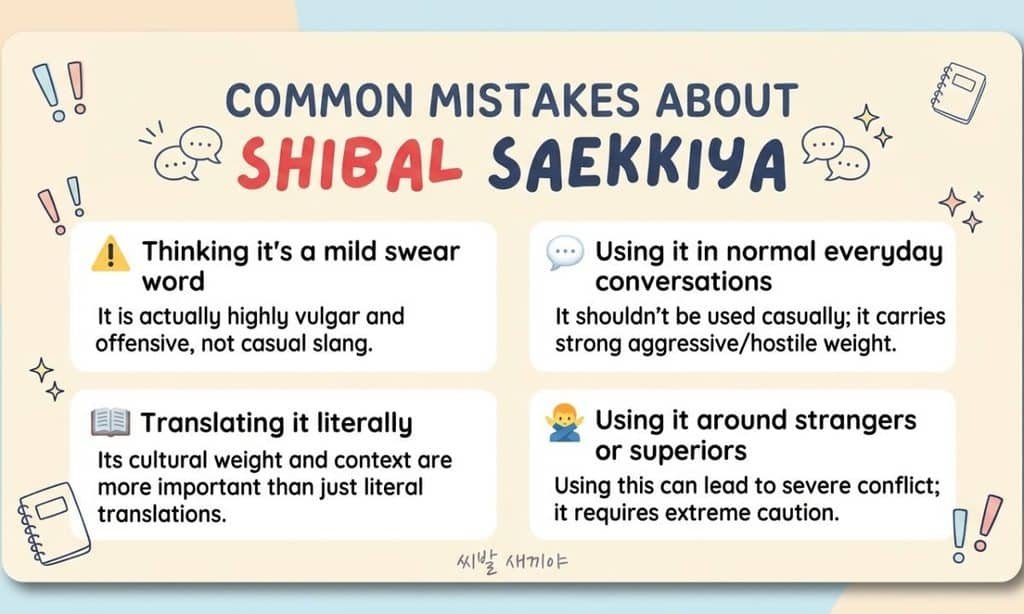
Mistaking Shibal for a Friendly Korean Expression
Some learners hear it in a joking scene and assume it’s casual or fun. It isn’t. Shibal is strong profanity, and Koreans react to it the way English speakers react to the f-word.
Learning Swear Words Only From Korean Dramas
Dramas show real emotion, but not the social rules around it. A word may be fine for a character in a heated scene and totally wrong for you in a real conversation.
Confusing Literal Translation With Actual Meaning
Translating “saekki” as “baby animal” misses the point. What matters is how native speakers use it: as an insult. Always look at meaning in context, not word by word.
Shibal Saekkiya Examples in Everyday Conversations
These examples are for understanding only.
Examples of Shibal Saekkiya During Arguments
- A person discovers a betrayal and yells the phrase at the person responsible. The meaning is “you f***ing bastard!”
- Two drivers argue after a near accident. One shouts it through the window as pure anger.
Examples in Korean Drama-Style Conversations
In a tense scene, a character confronts a rival and spits out the phrase before a fight. The subtitle might read “You bastard” even though the Korean is stronger.
Understanding Its Meaning From Context
Look at three things:
- Tone: Is the speaker shouting, laughing or whispering?
- Relationship: Are they strangers, enemies or close friends?
- Situation: Is it a fight, a joke or frustration at an object?
Those clues tell you whether it’s an attack or a venting moment.
YOU MAY ALSO LIKE: What Does Pegged Mean in Text? Shocking Truth (2026)
Related Korean Words and Their English Meanings
Aish (아이씨) Meaning in English
Aish is a mild exclamation like “ugh” or “damn.” It’s a softer cousin of shibal that people use when annoyed.
Jinjja (진짜) Meaning in English
Jinjja means “really” or “seriously.” It’s a very common everyday word and perfectly polite in casual use.
Mianhae (미안해) Meaning in English
Mianhae means “I’m sorry” in informal speech. Use it with friends and people your age or younger.
Gomawo (고마워) Meaning in English
Gomawo means “thanks” in casual speech. It’s the informal form of “gomapseumnida.”
Gae Saekkiya Meaning in English
Gae saekkiya means “you son of a b****” or “you bastard,” literally “you dog’s offspring.” It’s a strong insult.
Shibal Saekkiya in Korean Writing (씨발 새끼야)
The written form is 씨발 새끼야. Recognizing it in text helps when you see it in captions, comments or chats.
Shibal Saekkiya Song and Meme Meaning
You may also see the phrase in online humor, song lyrics and short videos.
What Does Life Is Shibal Saekkiya Mean?
I couldn’t verify one specific, widely recognized source for this exact phrase. In general, people use lines like this to say “life is brutal” or “life sucks,” mixing frustration with dark humor. Treat it as a sarcastic complaint, not a formal expression.
Why Is Shibal Saekkiya Used in Korean Memes and Songs?
It carries strong emotion, so it works well for dramatic or comedic effect. Online, it spreads because it’s easy to recognize and exaggerates frustration. In songs, curses like this are often used to express anger or rebellion, and they’re commonly bleeped on broadcast versions.
Frequently Asked Questions About Shibal Saekkiya
What Is the Meaning of Saekkiya in Korean?
Saekkiya means “you bastard” or “you jerk.” It’s the vocative form of “saekki,” used to call someone out directly.
What Do You Mean by Shibal Sekiya?
“Shibal sekiya” is just another spelling of shibal saekkiya. It carries the same insulting meaning.
What Does Shibal Seki Mean in English?
“Shibal seki” is a shortened or misspelled version of shibal saekki, meaning “f***ing bastard.” It’s still a harsh insult.
How Do You Say Shibal Saekkiya in Korean?
You write it as 씨발 새끼야, pronounced roughly “SHEE-bal SEH-kee-yah.” Remember that saying it is highly offensive.
What Does Shibal Mean in BTS?
Shibal means the same in any context: a strong curse. In K-pop, it’s usually bleeped or avoided in official releases. I can’t confirm specific lyrics, so check the lyric source before assuming.
What Is the Meaning of Shibal Saekkiya in Urdu?
In Urdu, it’s closest to strong abuse like “حرامزادہ” (harami-zada, “bastard”). It’s an offensive insult, not a casual phrase.
Does Shibal Mean I Love You?
No. Shibal is a strong curse and has nothing to do with affection. “I love you” in Korean is “saranghae” (사랑해).
What Is Shibal Gaesaekki?
Shibal gaesaekki (씨발 개새끼) is an even harsher insult, close to “you f*ing son of a b**.” It combines the expletive with the “dog” insult.
Conclusion
Shibal saekkiya is a very strong Korean insult meaning “you f***ing bastard.” It joins the expletive shibal with the insulting word saekki and the direct-address ending -ya. Dramas make it look casual, but in real life it’s offensive.
Knowing its meaning helps you understand Korean media, memes and conversations without confusion. Context, tone and relationship decide how it lands, and as a learner, the safest choice is to recognize it and not say it.
If you want to speak Korean with confidence, start with everyday words like jinjja, mianhae and gomawo. Mastering those will take you much further than any curse word ever could.

With over 6 years of experience researching language, word origins, and modern communication, our author is passionate about making meanings simple and easy to understand. Every article is carefully researched to provide accurate definitions, usage examples, and practical explanations.